
Harrell “Young Rell” Davenport — Young Rell

Now it is official: Please welcome Young Rell into the blues fold on the strength of his self-titled, long-play debut, Young Rell. The singing harpist/guitarist, known to his mother as Harrell Davenport, has just launched his recording career in the bold, gutsy way—by creating rather than copying. New songs instead of old. Fresh, not recycled. Only two outsiders snuck onto the setlist by way of a cover; the 10 other tracks stem directly from Davenport himself.
And as Shemekia Copeland once did (with 1998’s Turn The Heat Up), so has Davenport likewise unveiled his grand opening as a leader at the ripe old age of … 19.
Young Rell, indeed.
But this teenaged ‘old soul’ hasn’t just now burst onto the scene. There have been a few years of build-up. He has already been commanding airspace at festivals (King Biscuit, Calgary, Lucerne), inside Delta jukes (Red’s) and Chicago lounges (Rosa’s), as well as atop gorgeous turquoise seas (the Legendary Rhythm & Blues Cruise). Plus, he released a pair of standalone singles in 2025 that paved the way for this, his first full-blown record.
As harbingers go, “Tomorrow” is quite a good one for Young Rell, both the album as well as the man. It is probably safe to say that beginning blues guitarists often stand at a crossroads nowadays: Either travel in the (more-or-less) classic lane or barrel down the blues-rock one (or really floor it into flat-out rock). Seconds in, the answer is immediately evident. Because a beefy, pulsing shuffle about doing-you-know-what is always a reassuring start to any blues album. And right on cue, “Tomorrow” thumps in. Its guitar writhes, then strikes. A hard-edged harp adds extra insurance as to the chosen path.
Rell is fluent on both, splitting time between the two instruments for the session’s entire 47 minutes.
To that, add a warm, flexible voice capable of the sporadic falsetto uptick, which is the vocal equivalent of when he or wingman “Kid” Andersen shoot a guitar note soaring skyward with the bend of a string. Both methods tack on a prominent exclamation point to whatever statement is being made. And all the spontaneous outbursts—assorted grunts and grumbles, oohs and yeahs, and “Play it a long time,” when greenlighting Jim Pugh’s piano solo to take its needed space—affirm Rell is comfortable under the spotlight.
His writing shows that he has grown up quickly, not shying away from heavy stuff. “Fatherless Child” flips the script from “Motherless Children” (aka “Mother’s Children Have a Hard Time”), the gut-punch first thrown by growly Blind Willie Johnson in 1927, and then later by everyone from Eric Clapton to the Staple Singers. Rell’s original is a very separate lament unto itself. Loss, confusion and a resentful aftertaste color the words; lyrical harping echoes them.
Right on its heels, “Spinning” comes to your emotional rescue. It’s whole-body catharsis, an antidote delivered in the form of soul music. Rell’s own soul music. With saxophone and trumpet blazing away on bright-gold riffs that frame the infectiously singalong chorus (“you got me … spinning”), the love song swoons, majorly.
“The World Don’t Deserve Your Smile” likewise runs thick with mood. Except mood that slips back to the stylistic default mode of blues, by lining out lyrics in halting clusters that ride up and down on the melody—much in the way Magic Sam did on the West Side of 1950s Chicago. Soloing space is cramped; yet Rell’s Epiphone quickly exerts control with orderly discipline, extending from the steady string-by-string windup and that satisfying, little bend to those kamikaze drops before closing.
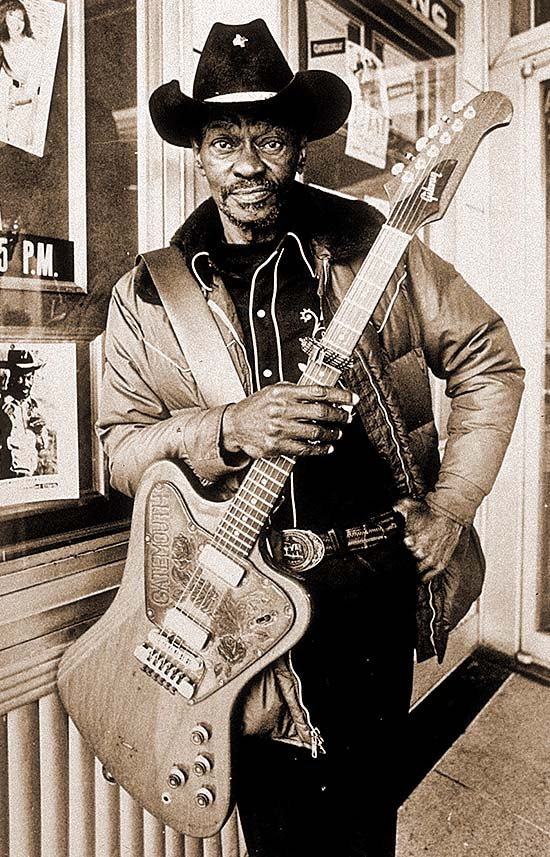
Somewhere up on high, Gatemouth Brown and Pee Wee Crayton are high-fiving to Davenport’s outright giddy “Richland Swing,” its sharp, bright, lightning-fast lines ricocheting around like a hummingbird stuck in a shoebox. Between the Lord-have-mercy horns and the boiling rhythm section, a lot of air gets moved. Not to mention the steady wind coming off Rell’s busy strings. The four minutes are an adrenaline rush on Davenport’s guitar, as much as “Nite Creepin’” is for his heavyset harp. It’s another wordless, open forum to let him rip, which includes extendedly holding that one hot, fat note—letting it burn, burn, burn—for seconds upon seconds. Tense and release, then back to buzzing at a quick clip.
In contrast to those go-go-go instrumentals is “Hurt People, Hurt People.” Not only do lyrics return. But you can feel the pace slow to a molasses crawl, as the harping loses its urban snarl for a downhome drawl of the kind championed by both Sonny Boys. “I Be Tryin’” keeps the harmonica tone clean—even throughout all the swooping and surging and rat-a-tat bursts prior to sending up a moonshot that settles back to earth in a gentle flutter. On the other hand, Pugh, having swapped over from piano to one of the more funky varieties of organs, sprays out retro grooviness with every squish of the keys.

“I Hear Some Blues Downstairs” reveals yet another of Rell’s skills beyond singing, harping, fretting, and songwriting: the art of the deep dive to supplement his own songbook whenever need arises. The ’70s-era song receives quite the nice revival, having been borrowed from Fenton Robinson, the late, undervalued Chicago bluesman who wrote it as a means of expressing infatuation with the music in general, much as did Z.Z. Hill’s “Down Home Blues.”

Last year, Davenport’s sleuthing turned up “Beefsteak Blues,” which served as one-half of those independent singles. The source was James “Son” Thomas, a bona fide Mississippi bluesman who served as the life—and soundtrack—of the Delta party. It was another fine excavation.

But Rell—frequently encountered bouncing between Mississippi (where he was raised) and Chicago (where he first broke big)—needn’t rely on re-creating since he creates a plentiful supply of his own material. Yet another fine example of such is “Giving Me the Blues.” This pulsatile airing of grievances sports a nice guitar solo that proves you don’t need speed or a flurry of notes to captivate; just the right notes with the right tone. Plus a couple of well-placed groans always help when beating those strings.
So, time has definitely come. Young Rell lets the cat out of the bag for the formal start of a long career.
Label: Little Village
Release date: 6/5/26 (digital), 7/10/26 (CD)
Label website: Little Village Foundation.com
Reviewed by Dennis Rozanski


Comments