
Ladysmith Black Mambazo — Beyond Graceland (DVD)
- Jan 7
- 5 min read
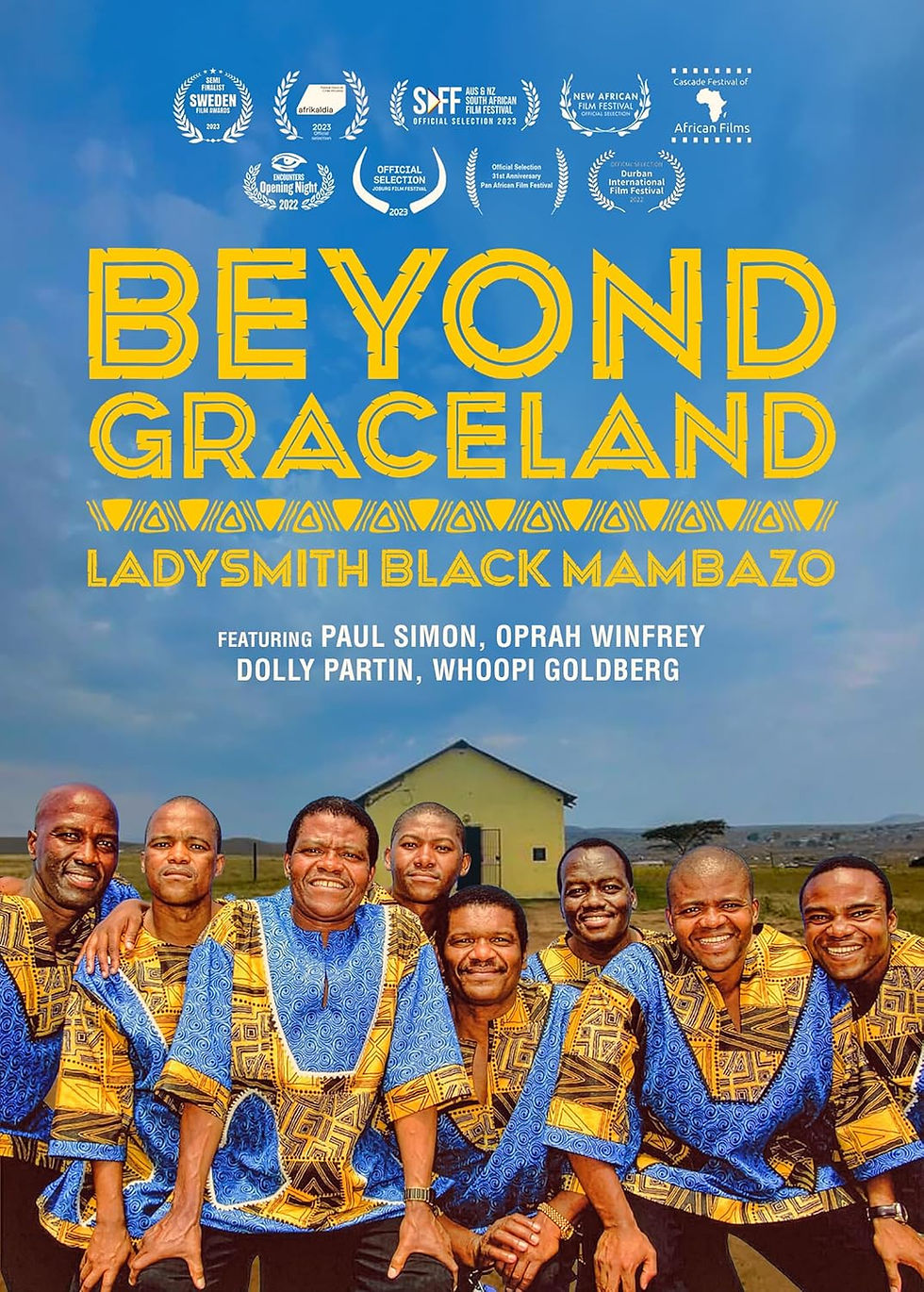
Hear them once—and Ladysmith Black Mambazo will stick with you forever. The a cappella Zulu godsend is assuredly that indelible. Five Grammy wins plus international stardom gladly vouch for the fact.
Filmed over five years, Beyond Graceland visualizes their career-spanning story, starting on South African dirt farms and winding up in Royal Albert Hall, Carnegie Hall, and on a stage near you as part of ongoing global tours. Oh, yeah: There are also those two 1980s records counted among 1001 Albums You Must Hear Before You Die. The 90-minute documentary also becomes the co-story of the vocal group’s visionary founder, Joseph Shabalala, who radiated inner peace, beamed an infectious smile, and demonstrated brilliance at blending voices (his included) into pure tone. “Harmony can bring people together,” professed the man who was clearly born to sing and to transmit joy in the process. Even his surname—Shabalala—rings out with a pleasing tunefulness. His brand of isicathamiya-style singing does all the more so.
Isicathamiya (is-cot-a-ME-Ya) is also a spectacle to behold, made so by choreographed moves to dovetail with the airtight harmonization. Numerous great, early clips of assorted isicathamiya choirs leave no room for doubt why this music is tied to the Zulu word for “tiptoeing,” a description fully merited by all the synchronized footwork and full-body routines. No, not even the Temptations could out maneuver those oh-so-cool platoons.

But perhaps you’ve already met isicathamiya, or, more precisely, its predecessor in mbube, without ever knowing it. Try this: See if Solomon Linda’s Original Evening Birds ring any distant, faintly recognizable bells with their golden oldie from 1939 Johannesburg, “Mbube.” (Correct, the song named the genre.) Or up the odds by jumping ahead to 1961, when its American pop adaptation crossed over the seas concealed as the Tokens’ “The Lion Sleeps Tonight” or ten years earlier as the Weavers’ lavish “Wimoweh.”
Still no bells? In 1986 came the shot heard ’round the world: Paul Simon’s Graceland album. Mega-huge. One of Rolling Stone’s 500 Greatest Albums Of All Time.

Instantly, Ladysmith Black Mambazo was a global phenomenon. Director Mpumi Mbele’s film certainly covers that period within its span from pre- to post-Graceland (soon to celebrate its 40th anniversary in August 2026). We get the scoop straight from Shabalala and Simon (“bewitched” by their beautiful sound), as abundant video airdrops you into the sessions and resultant concerts.

Quickly, Black Mambazo became a hot commodity. A year later, Simon produced their first U.S. release, Shaka Zulu, which wasted no time in winning the 1988 Grammy for Best Traditional Folk Album (as well as joining Graceland as one of those 1001 Albums You Must Hear Before You Die). Michael Jackson invited them into his Moonwalker project to perform “The Moon Is Walking,” witnessed as the film’s closing credits roll. Dolly Parton sprinkled some Africanization into her Treasures album; that presence expanded on their collaborative video for “Knockin’ On Heaven’s Door.” Taj Mahal, Dave Matthews, Des’ree, George Clinton, and Josh Groban are among those who’ve also lined up for a chance to bring a little Mambazo magic to their discographies.
You go everywhere tracing Ladysmith’s history: gliding high over the South African countryside; soaring atop the foaming ocean lapping against the nation’s coast; welcomed inside courtyards and homes peppered about the region; seated in the front row at humble, then grand and soon monstrous venues; disguised as a fly on the wall during candid rehearsals; attending Nelson Mandela’s Nobel Peace Prize ceremony; riding the tour bus. And, of course, you are privy to busy recording studios—stretched from Durban and Johannesburg to London (Abbey Road Studios, no less)—when records are being born, including one from Women of Mambazo, a direct offshoot.

Storylines are the sole property of firsthand sources, as interviewed family members, band members, producers (West Nkosi), recording engineers, and, of course, Black Mambazo’s multi-celebrity fan club fill in the lines. Count fellow South African musician Hugh Masekela among those ranks. Here and there, patches of vowel-rich Zulu dialogue remain untranslated, their secrets left unrevealed, but sometimes alluded to by the visuals. And visually, a mountain of archival snapshots and historic stills complement the wealth of footage, including home movies, sailing past.
And you’re never more than a few seconds away from being bathed in music. The film’s soundtrack overflows with warm, uplifting song.
Sure, on paper, titles like “Nomathemba” (Shabalala’s first song), “Dlondlobala Njalo,” and “Inkanyezi Nezazi” (the theme of ketchup and baked beans commercials that spread across the UK like wildfire in the 1990s) read like tongue twisters. But, in practice—glorious performance, of which there is plenty here—each flows off tongues like honey. Or, as once described, as “a ball of energy.” A ball of heavenly energy, full of hope. Always full of hope. Even in the face of violent unrest.

In addition to the comprehensive big picture, lots of interesting tidbits get picked up along the way. Like how Amabutho made history in 1973 for being the first long-play album waxed by a black South African band as a complete project, rather than cobbled together from a smattering of isolated singles. That special miking was required for their ever-so-soft singing. That Paul Simon used to fall asleep while listening on a Walkman to their African-made cassettes.
You spend lots of candid moments with Shabalala, too. That’s when he discloses that compositions as well as guidance would come to him by way of literal dreams during the night. That jazz, especially Louis Armstrong, lit him up. He also lays out the math used to come up with his ensemble’s name. “Ladysmith,” to start, is the South African town where he was born and raised. Add “Black” as an emblem of his group’s might, based upon the black ox being the farm’s most powerful resident. Finish with “Mambazo,” the Zulu word equated to chopping axe, a symbol of how his group would come to clear their own trail, vocally. Random chance did not figure into Joseph’s master plan.
All you need is the opening seconds of any one of countless songs to identify them as Ladysmith Black Mambazo. There’s something special in how their voices swarm immaculately. Soothing yet vitalizing. No less healing. And definitively distinctive. With overwhelming insight from everyone in the know—led by the dream weaver himself, Joseph Shabalala, who passed in 2020—Beyond Graceland pieces together the full audiovisual portrait of magical South African grace in (at a minimum) seven-part harmony.
Label: Pop Twist
Release Date: 1/20/26
Artist website: Mambazo.com
Reviewed by Dennis Rozanski
Trailer: https://vimeo.com/1133000845


Comments