
Freddie King — Feeling Alright: The Complete 1975 Nancy Pulsations Concert

During a temporary lull in an 18-minute public evisceration of “Have You Ever Loved a Woman?,” a deep voice booms into the centerstage microphone: “This is the blues … I’m a bluesman and I’ve got a blues band.” Sounds simple enough. But by that evening on October 10, 1975, such a humble statement of fact seemed like a massive understatement of the legend standing before everyone. Yet even at that early, early point—only half the way into the set’s opening number—he and his dagger-sharp guitar have them. Each and every one of them.
Fifty-some-thousand roaring onlookers packed into the Nancy Jazz Pulsations Festival turn to putty in his supersized hands. For two fiery hours, the highly influential string dazzler put on quite the show from behind a 1960 Gibson ES-345, distinguished by its lovely shade of “watermelon” red. And the vast crowd goes wild at every turn.
But that was nothing new for Freddie King.

The 6-foot-5 colossus—codename: the Texas Cannonball—had a knack for captivating mass audiences. Yet one-on-one sessions worked just as effectively. Go ask Eric Clapton, Stevie Ray Vaughan, Jeff Beck, and ZZ Top’s beardy frontman, Billy F. Gibbons: all devout members of his elite fan club. Because King was a string-bending, treble-stinging epiphany that struck many a guitarist like a bolt from out of the blue. His flashpoint energy and intense fretboard attack flipped the ignition switch for those straddling the blurred line dividing blues from rock.
All that adrenaline and awe was on grand display under the stage lights in Nancy, a music-loving city in France’s northeast corner. King, along with his crack five-piece band (zero horns but double the keys, employing both organ and piano), was in town for the huge festival. He made his appearance at the prestigious event count.
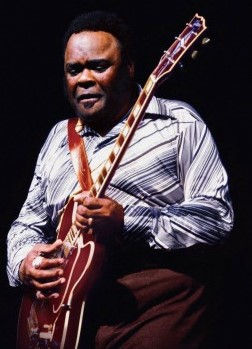
For one thing, the Texas-born, Chicago-schooled King knew how to escalate situations with the flick of a wrist or by bearing down on a string just so in order to sail notes up high and away while taking heart rates with them. Right from the get-go, that leadoff slow blues, “Have You Ever Loved a Woman?,” brings you to the edge of your seat with a touch so painfully soft yet piercing, only to then yank you to your feet seconds later with a moonshot bend of the strings or a lick flooded with scalding notes. You feel the exhilaration in “Going Down” transfer from King to you, even across all this intervening time and space. “Stormy Monday Blues” smolders with an extended guitar soliloquy. “Sweet Little Angel” doesn’t even reach its first wing-spreading lyrics until eight minutes in, not until after multiple crescendos have been breached. And speaking in bright, taut treble tone, the guitar’s default inclination is already antsy and anxious. Most times so is his singing.
Such command sends the thousands upon thousands of festivalgoers heaving in unison with him in call-and-response to the chorus of “Got My Mojo Working.” Or he hooks them by teasing and teasing at kick-starting “Hey Baby,” revving the riff until the band’s clutch finally engages. Then, off in a whoosh the six of them bolt at a mad tempo that carries them seamlessly into Chicagoan J.B. Lenoir’s “Mojo Boogie.” As if not already brisk enough, they upshift into double time for extra kicks right before crash landing after 11 combined minutes.
Want to hear utter fearlessness?
Jump to “Whole Lot of Lovin’.” Specifically the 3:55 minute mark, where one note is struck and then held … and held … and held for just shy of 30 seconds, stretched like a tightrope across the stage, wringing out all of its increasingly rising tension until that same note finally gets chopped off, relieving the vice grip, releasing the band to collapse into an ending—that turns out to be a false one—before they immediately ramp back up again.
Call it fearlessness—or bold-faced audacity or the art of good ol’ showmanship. Either way, King was fluent in high drama.

And, yes, tape had been rolling the entire time—but then quietly forgotten until producer Zev Feldman recently picked up the scent. He’s the sleuth heralded for tracking down lost treasure. Among his prior rescues are B.B. King’s In France (Live At The 1977 Nancy Jazz Pulsations Festival), Sister Rosetta Tharpe’s Live In France (The 1966 Concert In Limoges), Wes Montgomery’s In Paris: The Definitive ORTF Recording, and John Coltrane’s Offering: Live at Temple University.
Like those projects, the never-released Feeling Alright likewise receives first-class treatment. The Complete 1975 Nancy Pulsations Concert, transferred from the original tapes and beautifully mastered, sprawls across a limited-edition 3-LP or two-CD set. Twenty-four pages of accompanying essays and reflections provide backstory (Cary Baker), inside story (Wanda King, Freddie’s daughter), and fan testimony (the previously mentioned Billy F. Gibbons).
Meanwhile, back on stage, the night’s setlist keeps overflowing with hits and road standards: 16 tracks in all. But within that count is a grab-bag medley or two, like the hyperactive one sewing together his own “Sen-Sa-Shun” with Magic Sam’s “Lookin’ Good” and John Lee Hooker’s “Boogie Chillun.” Nine dizzying minutes of hyperventilation. Plus, unannounced surprises also crop up, such as when “Rock Me, Baby” and “The Sky Is Crying” are found lurking inside “Have You Ever Loved a Woman?.”
For as much as Freddie may occasionally borrow material from others, running across others borrowing from him is a cinch. Because, along with his guitarisms, King’s repertoire quickly became common currency. Take your pick: “Have You Ever Loved a Woman?” caught the ears of Derek and the Dominos. “Going Down” got snapped up by the Jeff Beck Group. “Woman Across the River”? The Allman Brothers were all over that one. And “I’m Tore Down” lit up the stage under Jeff Healey’s fingers flying over his lap-laid guitar.
Then there are Freddie’s other hot commodities: namely, the early-1960s instrumentals. Of

them, “Hide Away” was the hottest. Again, take your pick: Eric Clapton helped enshrine it as a member of John Mayall & the Bluesbreakers. Stevie Ray Vaughan cut it during the sessions for his sophomore album, Couldn’t Stand the Weather. The Grateful Dead would ease into it on occasion. Johnny Winter, of course, opted to rip through it. And Joe Bonamassa gussied it up with a horn section. But that’s not to say King’s other wordless wonders like “The Stumble,” “San-Ho-Zay” or “Sen-Sa-Shun” didn’t have their share of avid followers: The Yardbirds, Jimi Hendrix and the Paul Butterfield Band, and Hound Dog Taylor vouch for that, respectively. All of which is a long-winded way of making the point that Freddie King held major sway across two major, interwoven genres: blues and rock. Many a disciple are out there.

Tonight, though, this is the real deal before you: straight-up, full-force Freddie. No substitutes, no interpreters. Plus, miles removed from those early woodshedding days as a sideman (for instance, Smokey Smothers’ Sings the Backporch Blues, a crown jewel of gutbucket grinds) or even from his first solo recording, 1957’s uneventful “Country Boy.”

The setlist is jammed solid with blues: Junior Wells’ “Messin’ With the Kid,” Jimmy Rogers’ “That’s All Right,” Big Joe Turner’s “Wee Baby Blues.” All upgraded for the modern blues guitar. However, the title track makes a point: Freddie didn’t always need a song drawn from the ranks of blues. He just needed a good song. Something he—and, evidently, his billowing organist, too—could dig into and explore the possibilities. Fitting that bill was the slinky funkiness inherent in “Feeling Alright?,” pinched from Dave Mason-era Traffic (and then notably covered by Joe Cocker the year after, in 1969). The audience audibly latches onto King’s sheer delight in grooving to the loose vibe.
For sure, he was feeling better than alright.
Yet midway through “Hey Baby,” his 1961 single, Freddie barks out an age-old blues lyric that didn’t raise eyebrows at the time but would soon ring chillingly fateful: “I believe my time ain’t long.” Little could have anyone fathomed that only one year after this vigorous show, the very vibrant King would be dead in his prime, stolen by stomach ulcers and an enraged pancreas at the age of 42.
That’s why this Complete 1975 Nancy Pulsations Concert is so valuable in getting to spend two rare hours with the King at his peak—absolutely live and alive.
Label: Elemental Music
Release date: 4/18/26 (for LP); 4/24/26 (for digital and CD)
Label website: Elemental Music.com
Reviewed by Dennis Rozanski


Comments